.png)
 5 days ago
12
5 days ago
12

Published Jan 29, 2026, 9:00 AM EST
In this tough, mesmerizing mountaineering game, climbing is combat
 Image: The Game Bakers
Cairn, a new rock-climbing sim by Montpellier studio The Game Bakers, is a video game about what it’s like to have a body. Playing it, you feel the protagonist Aava’s muscles tremble and her breath labor. You monitor her temperature and hunger and thirst, her tiredness, her concentration, her balance. You move her limbs one at a time, searching for ledges and cracks, feeling out grip. You slip and fall, losing minutes of progress, and Aava howls with frustration. Then you pick yourself up and start again.
In this, Cairn is like nothing so much as last year’s Baby Steps, a game about the determination it takes to literally put one foot in front of the other. But Baby Steps is played for slapstick comedy, and its default stance is a sort of amused incredulity at the physical world: Isn’t it hilarious that we’re all wobbling about in these ungainly meatbags?
Cairn is different, in that Aava is all grit and competence and daring, and the world she inhabits — the crags, caves, and cliffs of a towering mountainside — is majestic and perilous. But maybe it’s not so different as all that. Aava’s ascent isn’t always elegant, and her path is one of determination in the face of weakness and failure.
Here’s another useful comparison for you. In 2023, another French studio, Don’t Nod, made another rock-climbing adventure, Jusant. In premise, structure, and moment-to-moment gameplay, Jusant is a lot like Cairn, but Don’t Nod’s game is rhythmic, meditative, and mentally cleansing, and its climbing walls are like platforming puzzles to be solved. In Cairn, climbing is combat. It can be just as mesmerizing to play, but it’s tense and fraught with risk and uncertainty. Every rock face is a bloody, heart-in-mouth battle to get to the next safe space. Short of one of Dark Souls’ bonfires, you’ll never be so pleased to see a save point.
 Image: The Game Bakers
Cairn works like this. Start climbing, and you move Aava’s limbs in turn, pressing a button to select the next handhold or foothold. Based on her weight distribution and grip, the game decides which limb should be moved next, but you can override this if you want. The rock faces are not like Jusant’s clearly demarcated climbing walls; they’re rock faces, and you have to search them with your eyes, sometimes turning the camera this way and that, to figure out where the next precious inch of grip can be found. Reading the rock is one of the key skills you need to develop in the game.
Unless playing in the hardcore, permadeath Free Solo mode, you can place self-drilling pitons for a little security, a stamina refill, and a moment’s respite for Aava’s limbs. But get the timing of your button press wrong and you might break or twist a piton, making it unrecoverable by the climbing bot that follows Aava around. Like everything else in Cairn — food, water, daylight, clear weather — pitons are a precious resource.
More precious still, when climbing, are stamina, stability, and grip. The Game Bakers wants you to be as focused as possible on Aava’s physical experience while climbing, and has decided to communicate these factors solely through sound, animation, and vibration. The placement of her hands and feet tell you how much grip they have, the trembling of her limbs in the animation and through gamepad rumble tell you how much strength she has left, the sound of her breathing tells you how strained or panicked she is. If things get really dire, a dark iris starts to close in around her, and you know she’s about to fall.
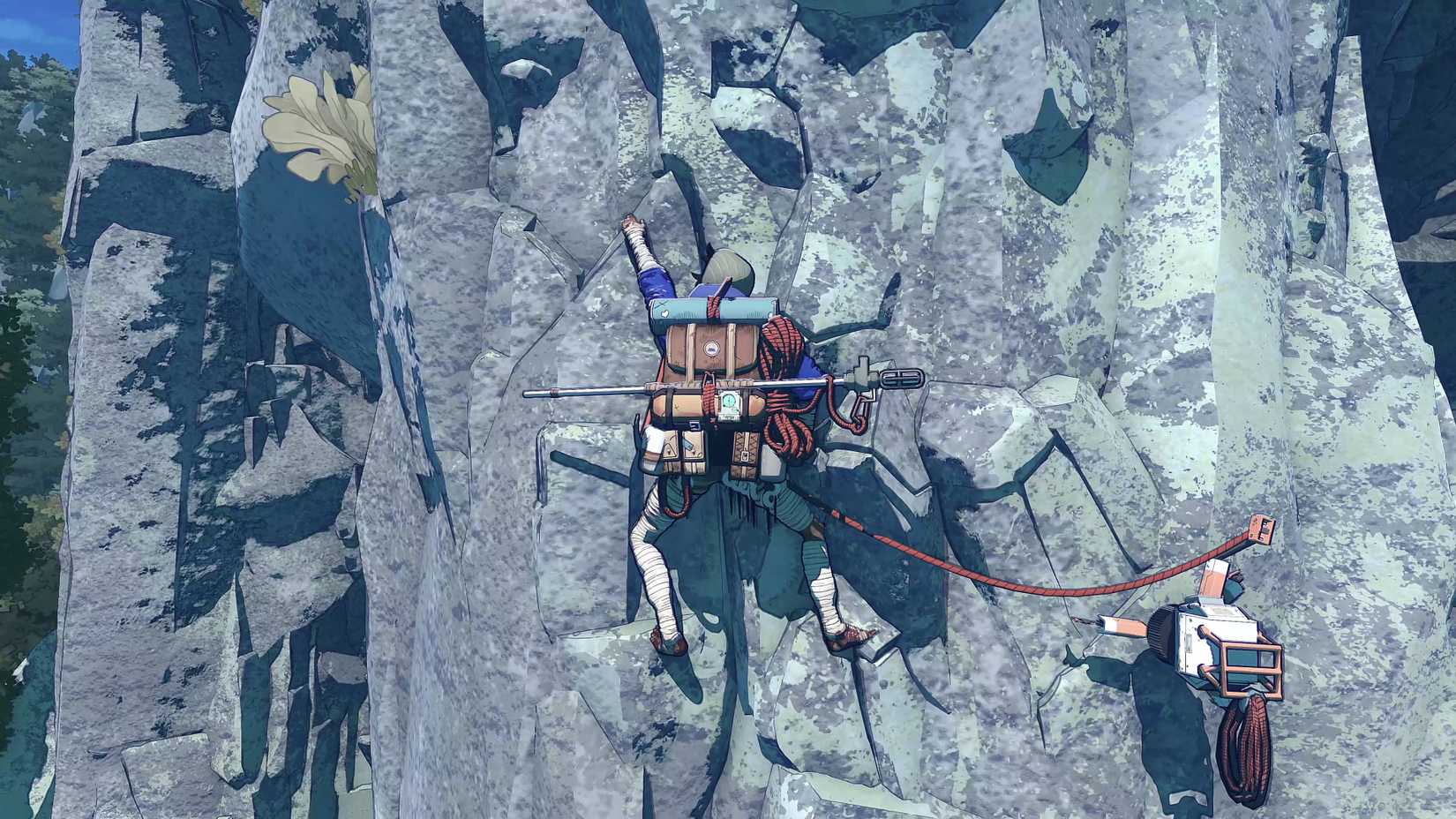 Image: The Game Bakers
In terms of immersion, this approach is tremendously effective; you can see how your in-the-moment connection to Aava might be broken if you were watching a line of status meters. But it can also be frustrating and opaque. Cairn can be inconsistent, and it can sometimes be hard to understand why Aava is struggling. It’s defiantly a game of feel, but one that’s overlaid on a relatively detailed simulation, and not giving the player access to the simulation’s workings can cause some dissonance.
This isn’t necessarily the wrong choice. I think The Game Bakers set out to make a game in which dealing with a lack of certainty is an intrinsic part of the courage and thrill of climbing, and asking the player to feel Aava’s purchase on the rock rather than know it is totally consistent with that. It makes the game more focused and gripping, but it also — and again, this might be deliberate — makes it more cruel.
It’s quite easy to die from a fall and have to restart. It’s even easier to not die, but end up so far back, or so badly hurt, or both, that trying to recover makes less sense than reloading your save — which, on difficult sections, could easily be 15 minutes or more of stressful gameplay ago. Cairn is an old-school challenge, measured out in a series of widely spaced checkpoints where you can save and set up a bivouac to cook, sleep, tape your fingers, recycle broken pitons, or simply while away time until the rain stops or the sun comes up.
 Image: The Game Bakers
The Game Bakers’ sense of pace is interesting, though; this is not simply a game that gets harder as you get deeper into it (although it does). The developers are as happy to throw in some very challenging ascents early on as they are to modulate the pace with easier passages, peaceful cave exploration, and unexpected story beats.
Cairn is a lonely game, as you might expect — and want — a game about alpinism to be. Finding clues left by fallen climbers conforms with that expectation, as does stumbling upon the abandoned remnants of a troglodyte community that has long since left the mountain. But The Game Bakers is willing to puncture this mood, too. Aava, a veteran mountaineer, is annoyed to discover she’s not alone on the peak, and there’s a cheery younger fanboy climbing alongside her.
Occasionally, her climbot chirrups with voice notes from her life “on the ground.” When she gets a message from her irritating social media manager asking for updates and photos, she scoffs and ignores it. Fair enough; such material concerns only sully all this beautiful solitude, this lonely battle of wits with the mountain. But when she gets a message from her partner to say that their cat is dying, she shrugs that off too, and you wonder if she’s running away from something as much as climbing toward it.
There’s a gentle suggestion here that focus and determination come at a human cost, and that all ascents aren’t inherently noble. This is a survival game that’s more about walking away from comfort and ease than trying to reclaim it. Cairn is hypnotic and rewarding, but it can be tough and bitter, too.
Cairn is out now on PlayStation 5 and Windows PC. The game was reviewed on Windows PC using a prerelease download code provided by The Game Bakers. You can find additional information about Polygon’s ethics policy here.







 English (US) ·