.png)
 2 days ago
3
2 days ago
3
The cinematographer behind One Battle After Another revealed how he filmed the movie’s breathtaking car chase scene and how he pushed the VistaVision format to its limits.
One Battle After Another, directed by Paul Thomas Anderson, follows a former revolutionary named Bob (Leonardo DiCaprio) who is forced back into action when his long-time enemy Colonel Lockjaw (Sean Penn) kidnaps his daughter Willa.
One of the film’s most talked-about scenes is the thrilling car chase, in which Willa is pursued by a hitman through a series of steep hills, while Bob follows closely behind. The climactic sequence takes place along a stretch of rolling terrain known as the Texas Dip and has become a standout scene in One Battle After Another, which has received 13 Academy Award nominations.
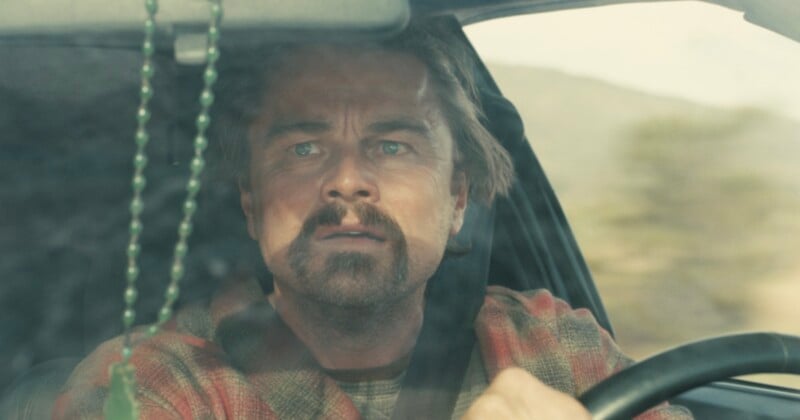
In an interview with Variety, cinematographer Michael Bauman explains that the scene was both visually ambitious and technically demanding, particularly because it was shot using VistaVision. The large-format film system is rarely used for extended, high-speed action and requires careful planning.
The tense sequence was filmed in Borrego Springs, near San Diego, a location chosen for its unusual topography. According to Bauman, Borrego Springs’ steep hills and dips were essential to the way the chase plays out on screen. He says the terrain allowed the cars to vanish and reappear over crests and “was really critical to building how the two cars chase each other in the cat-and-mouse game on the way to the end.”
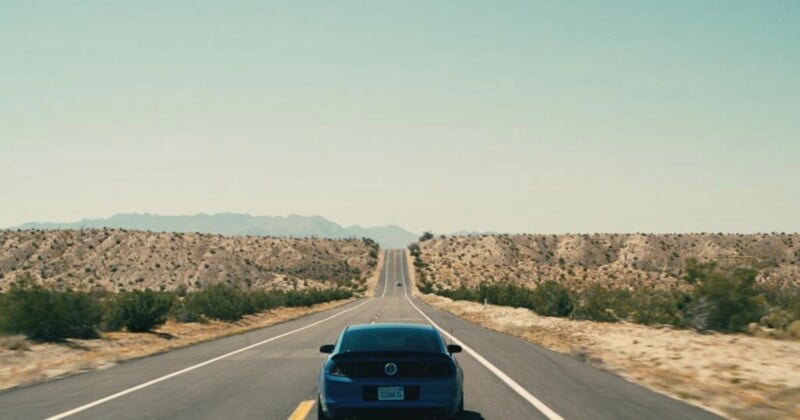
To emphasize this effect, Bauman positioned cameras at the side of the road using extremely long lenses, ranging from 1,000mm to 1,200mm. This compressed the distance between the cars visually, making them appear stacked closely together as they rose over the hills.
Mounting VistaVision Cameras onto Cars
Another major challenge was how to move the cameras safely and precisely at speed. Bauman tells Variety that he worked with Allan Padelford Camera Cars, a specialist company he had previously collaborated with on Ford v Ferrari. He describes Allan Padelford as “one of the old school masters of camera car usage” and credits his custom-built systems with making the sequence possible. Bauman, camera operator Colin Anderson, and key grip Tana Dubbe spent a full day testing different setups. They found that mounting wide lenses just inches above the road surface created a strong sense of motion.
“It was really clear that while we were doing that — using wide lenses close to the ground, just a few inches off the surface of the road — was super effective for creating a dynamic sense of speed,” Bauman explains. “Even on our small monitors that we were looking at at the time, we could tell that was really going be some powerful stuff.”
He adds: “We were able to take that out onto the river of hills and really lean into all that emphasis of speed and scale. It just had an incredibly powerful effect when we saw it for the first time in dailies.”
Filming on an active road added further complexity. Bauman notes there was heavy traffic in the area, so the crew operated in short, carefully controlled windows. They were given around 10 minutes at a time to close the road, position the vehicles, and complete each run safely.
In a further departure from standard practice, Bauman mounted the vintage Baumont VistaVision camera directly onto the cars. The system was originally designed to remain stationary on a tripod, but for this sequence, it was attached to moving rigs that allowed it to race alongside the action and skim close to the ground. Bauman says the production pushed VistaVision further than it had been used in decades.
“This camera system hadn’t really been used at this quantity of film because we shot about 1.5 million feet of film for the project,” he explains. “This camera system hadn’t had that kind of level of film run through it in a long time. And so that inherently had its own problems, especially when it’s vibrating along us — we’re going 70 miles an hour — and so we had to discover methods of working within the parameters that the camera would give us on any kind of day.”
“It really underscores the power of shooting on film and what VistaVision is as far as projecting it.”
Image credits: All photos via Warner Bros.



 English (US) ·