.png)
 1 week ago
35
1 week ago
35

Making a camera backpack is not easy. Photographers rarely look for the same features in a bag, and everyone has an opinion on what they want, which makes creating a singular design that everyone will like simply impossible. Hasselblad decided to try and, in doing so, managed to do something few makers have managed: make a unique and exceptional interior.
I picked up a Hasselblad Vandra backpack at the tail end of 2025 and have used it extensively on three long-haul flights (and the associated travel away from home) and as a day backpack through that time and while I have some issues with other aspects of it, the interior is so smartly designed that I keep going back to it, even when I have other options that might be more comfortable to wear.
Because while it’s not the best feeling bag on my back, especially when it’s full of gear, it remains one of the only options I have that is compact while simultaneously big enough on the inside to hold some of my larger and smaller cameras, a bag of film, batteries, both a laptop and an iPad, my tech pouch, and other travel items like a Nintendo Switch, my glasses, and a water bottle.
There is something to be said about having space — smartly implemented space — that will trump other issues with a bag. There is also the conversation over price and value, which will, of course, vary from person to person, but it’s pretty inarguable that the Vandra is pricey at $469. All this said, I think for many, the Vandra will be a perfect example of a product that has flaws that can be overlooked because of the benefits.
Hasselblad Vandra Review: Build and Design
For the aforementioned $469 and the Hasselblad name, you would be right to assume that this backpack is built very well. The front of the bag, which features a large Hasselblad “H,” has a textured woven fabric that leads down from the top and into a faux leather base that has a more subtle embossed full “Hasselblad” logo. For those in the photo community, the “H” is immediately recognizable. However, I would argue that outside of our niche, it’s not as well-known of a logo as you would expect and the fact that the full word “Hasselblad” is not easy to see, the bag doesn’t immediately scream “expensive camera” unless you’re stowing a tripod on one of the side pouches, despite what I think many photographers might think. This is, of course, just my opinion.
Going the other direction, the top of that woven material leads to a top access pouch that is held in position by two magnetic clasps. That allows the top to close quickly and easily, but opening it must be an intentional decision.
 This is a look at what I brought on a recent cross-country trip. From left to right: a Peak Design Tech Pouch, Nintendo Switch Pro Controller, pouch of film/Airpods/portable battery, Fujifilm X100VI inside of a Wotancraft pouch, Sasquatch 617 panoramic camera, Nintendo Switch, iPad Pro, MacBook Pro.
The back of the bag is a pretty standard giant zippered door, which gives you access to the entire bag, including the area that is accessible from the top pouch. Without dividers — which we will get to in a bit — the Vandra is just a giant cavernous interior. The door has two pockets in it, one with a Velcro loop that holds a laptop in place, and the other is magnetically clasped closed and is probably meant for paperwork or other small, flat objects, but I use it for my iPad and have had no issues with those two items stacked against each other.

Incredible Interior
Now we can talk about the best part of the Vandra: the divider system. It feels like Hasselblad spared no expense with the quality of the materials here, because this is the most robust, high-quality divider system that I’ve ever used. It leverages a mix of the expected Velcro-edged dividers with larger panels that hook into loops that run up the side of the interior. The inside of the bag also has lines that allow you to easily see where you should be placing the larger dividers so they’re always straight — why isn’t anyone else doing this?
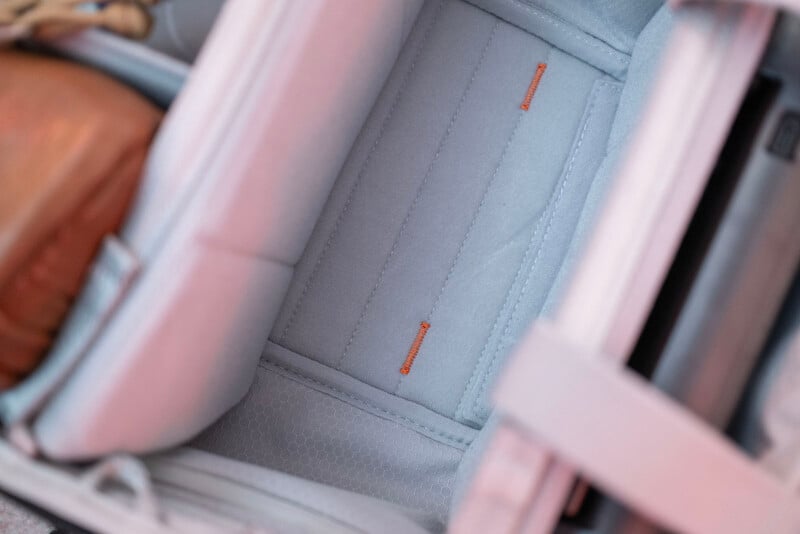 When you line up the horizontal dividers, you can always get them perfectly straight thanks to the sewn-in guides.
When I first opened up the Vandra and started customizing it, I was loudly talking to myself about how smart this system is. I could not believe how user-friendly it was. I wanted to know what led Hasselblad to this design, and so, in a shift from what we usually do here with reviews, I’m going to include some quotes from Hasselblad’s design team about how and why they came to this system.
“[The Vandra] was designed by the Hasselblad Industrial Design Team. The team’s experience comes mainly from industry research and user insights into comparable products, including consumer electronics and photography equipment backpacks. Throughout development, the team continuously iterated on and upgraded the product, primarily by observing users’ behavioral habits and how they carry combinations of photography equipment. Their goal has always been to provide photographers with a better overall user experience through the Hasselblad Vandra Backpack,” the design team explained to me.
“During the development process, the biggest challenge we encountered with liner segmentation was the wide variety of camera devices on the market, all with different sizes. This makes it difficult to meet all equipment needs using one or several fixed formats. Because of this, we adopted a more flexible approach, providing photographers with a convenient space for DIY customization that remains compatible with diverse photography equipment. Other solutions exist, such as replacing the entire inner liner, but from a user’s perspective, this is not efficient enough, especially when photographers are already outdoors and need to adjust the storage space inside the bag at any time.”
 The larger dividers are held in place by Velcro on the bottom but then loops on the sides keep them from falling down.
My goodness, is that last part right on the nose. For at least a decade now, most camera bag brands have been using some iteration of the swappable cube system, which was popularized by Fstop Gear. Now ubiquitous, this system really never quite made sense to me outside of adventure backpacks, where you would, occasionally, want to use the bag for something other than carrying cameras. But having a different cube for different camera configurations always felt like I was going to collect more cubes than I needed to, or should. It felt wasteful. Beyond that, most companies never evolved the same divider material design, and most, if not all, are flimsy.
 The included vertical dividers are very strong despite being thin.
“The three partition panels are removable and foldable, allowing photographers to freely arrange the interior layout according to their own needs, and to store additional lenses, camera bodies, and other equipment,” the design team said, and that’s the best part of this bag. Hasselblad’s large horizontal dividers are extremely rigid despite this flexibility, and the smaller interior dividers — of which the company supplies you a bunch more than you’re likely to need — are also very rigid. Once you have an arrangement you like, it’s going to stick in place, and your gear is going to stay safe. If you want to change it, it’s not a huge hassle, and the bag’s built-in guides make sure you always keep dividers correctly spaced from one another.
One of the issues might be that it’s possible to really fill this bag with quite a lot, which might push its weight beyond what Hasselblad intended. It’s meant to hold up to 26.5 pounds, but I’ve probably pushed it further than that.
Hasselblad Vandra Review: In Use
That leads us right into what it’s like to use this bag. As I mentioned, the visible part of the bag has a woven texture to it, and while this does provide a premium look and feel unlike any other bag I’ve seen, it has a downside: pet hair loves to get stuck in it. In fact, this fabric will grab onto and hold a range of foreign materials, which is a real shame considering that this part of the bag is going to come in contact with surfaces more than any other, since you usually won’t be trying to access the core of the bag without setting it down. Yes, there are quick-access side zippers, but I personally don’t organize bags to have quick side access, so I never use these.
 Pet hair loves to stick to this thing. That’s not the thread of the “H” logo fraying, that’s my dog’s hair stuck to it.
The shoulder straps could also use more padding. They’re not particularly robust, and while they do sit on my shoulders well, the bag will start to dig into my collarbones pretty quickly, especially when I pack the bag full and reach (or exceed) the intended carry capacity. The chest strap is fine, although I think they could use a different clasp that is easier to attach and detach one-handed. Right now, it can be a bit fiddly.
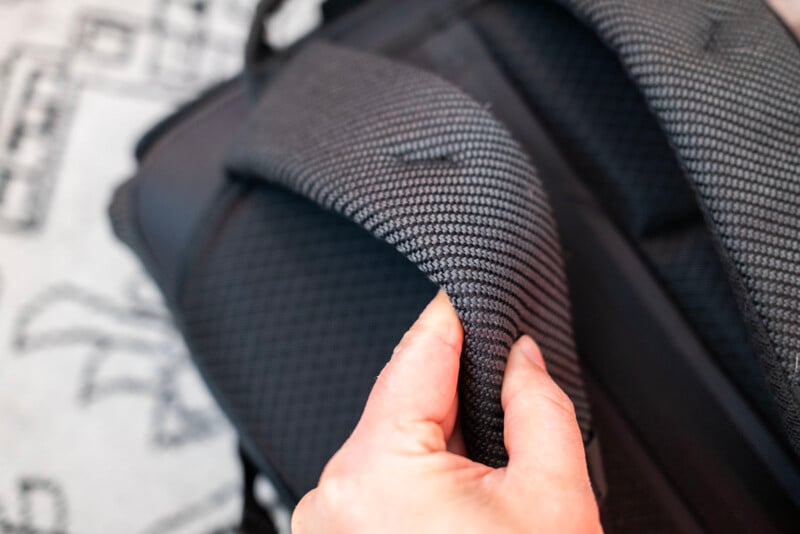
There is no waist strap, which I think is perfectly fine, but I just thought I would point it out. The side pouches are also pretty pedestrian, and it’s clear Hasselblad spent the majority of its design time on other aspects of the bag. I don’t like traditional side pouches for carrying a tripod (they always end up sticking up way higher than the height of the bag and never feel very secure), and Hasselblad’s design is particularly tight. I have a medium-sized water bottle that feels like it is pushing the limits of how much those side pockets can stretch out.

I think the Vandra succeeds because it’s deeper than you might think. Many bags have space for tall cameras and lenses when configured one very specific way, but the Vandra is deep enough to accommodate my biggest camera — the Sasquatch 617 — not only width-wise, but also depth-wise. The Sasquatch is a big camera, and the Vandra is the only bag I own that fits it perfectly.
 I pulled the Sasquatch out of the divider so you can see just how huge it is and how well it fits in the Vandra.
I am happy to report that the Vandra will stand up straight when you set it on the ground. Too many bags just don’t have the balance or structure to stay upright, even on flat surfaces, and will instead flop over on the front or back. The Vandra strikes a great balance here — literally.
The entire bag is water-resistant, despite being a woven material, although there is something about it that makes me uneasy. I don’t know if the woven material would absorb water and get heavier or eventually start to smell (probably not, but it’s just something in the back of my mind), but that’s okay, because Hasselblad does include a rain cover should you enter a real downpour.
I also think that the top access panel needs a bit more time in the design oven. I mentioned that it easily clasps closed with magnets and that you have to be intentional about opening it. That’s true, but you have to be really intentional.
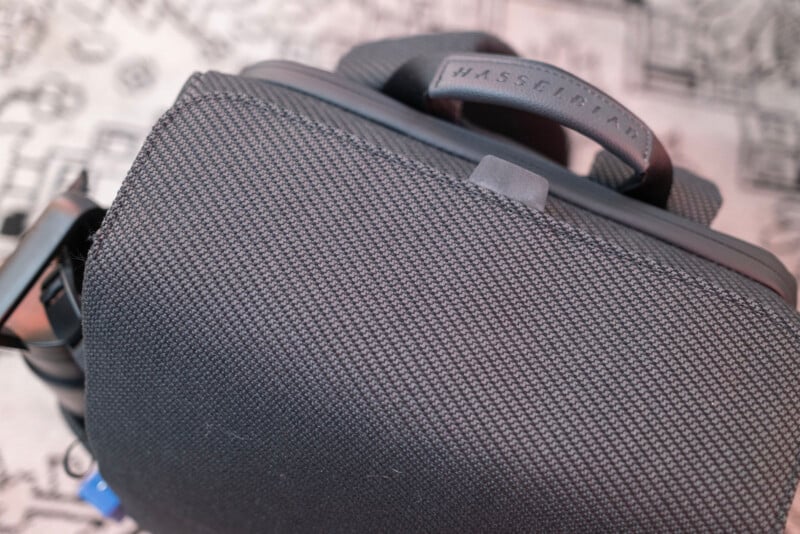 This little pull tab isn’t cutting it.
It’s got a sort of pull-apart design, and there is even a little leatherette pull tab right in the middle that looks like it’s supposed to be your purchase point. It works badly, and I find that I have to squeeze the bag together and yank on each side of the top pouch one after the other in order to get it open with any regularity.

All of this is to say that I think the Vandra is an excellent bag for getting onto and off of an airplane, from home to hotel, but not great for a day on the streets with your camera. That’s not an uncommon conclusion for me to reach when it comes to backpacks, but I think with a bit more refinement, it could definitely get there.
The Hasselblad Vandra Pushes Backpack Design in the Best Possible Way
Hasselblad says that it spent a year designing and iterating on this bag to get it to where it is, and that really shows — especially with the interior. If Hasselblad were to take this design and refine it, perhaps with more robust shoulder straps, a better chest strap, and better side pockets, we’d really be cooking with gas.
Even if the Vandra isn’t for you — and that’s likely given its price and limitations — I think we need to give Hasselblad some serious credit for pushing bag design in a new direction. I’ve been tired of the same Velcro interiors and cubes for years, and Hasselblad finally gave us something to change the status quo. I hope that this is an inflection point like that cube system was and will lead to smarter, better bag designs going forward.
Are There Alternatives?
My heavens, there will never be a segment with more alternatives than the backpack market. Right now, the bags competing for my attention in this kind of use case are the Shimoda Urban Explore, the Peak Design Everyday Backpack or the company’s Travel Backpack. Shimoda comes closest to nailing all the right elements of a great travel backpack, but relies on that old cube system I mentioned that doesn’t quite get interiors right. It’s still a great bag, though.
The two Peak Design options are weaker, in my opinion. The Everyday Backpack is very heavy even when empty, and the divider system and access to the interior feel clunky and dated in contrast to both the Hasselblad and Shimoda designs. That said, it remains popular. The Travel Backpack has its own set of issues, but mainly the fact that it’s just not very good for cameras.
You can also, of course, look at options from Wandrd, Pelican, PGYTech, but you’ll start seeing a pattern: none of them are approaching interior design the way Hasseblad did.
Should You Buy It?
Maybe. I think that if you’re like me, you’re going to find huge value in the interior design — enough to blind you to the other issues the bag has. No other backpack offers quite what the Vandra does, and that is going to be compelling to a good number of you, I think.





 English (US) ·